How does centroid decomposition work?.
June 26, 2022
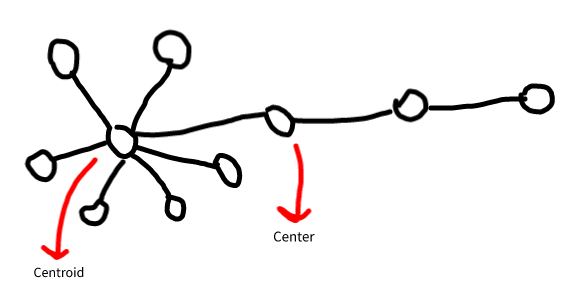
Centroid
The centroid is the node that, when removed, minimizes the size of the largest component formed.
Let be the subtree size for each node .
- , if
vis a leaf. - , otherwise.
So the centroid is the node with the minimum value of the maximum over all subtree sizes and the leftover parent tree, i.e.
.
The centroid is the node which minimizes .
Properties
- A tree has at most 2 centroids. And if there are two, they must be adjacent.
- Removing a centroid divides the tree into components of size .
This is why centroid decomposition works. Just like binary search halves an array, a centroid splits a tree into subtrees of less than half the size.
So divide and conquer on trees uses centroid decomposition. Other similar DnC techniques are merge sort and binary search.
A tree can be decomposed into a centroid tree by recursively finding centroids of subtrees, and this can be used to solve path queries with precomputation and LCA.
Divide and conquer on trees
Since centroid decomposition divides trees into components of at most , the worst case is — though in practice some time is saved, as we don’t always split into exactly 2 subtrees.
Pattern
- Solve the problem for all paths going through some node.
- Remove the node.
- Solve the remaining subproblems.
Yin Yang paths (simpler)
Given a tree with nodes, some edges black and the rest white: count the number of balanced paths.
.
Solution:
- Count paths through the centroid.
- Remove the centroid.
- Solve for the subproblems.
There can be at most balanced paths: imagine a star-shaped graph with black edges and the rest white — we need to count paths through the centroid quickly.