Why do we need Fenwick trees?.
June 19, 2022
Why are Fenwick trees / Binary Indexed Trees (BITs) needed?
Plain prefix sums have query time but recompute time on every update. A BIT fixes the update side. Segment trees can do the same operations, but a BIT is easier to code and faster.
- An element in the BIT is responsible for a number of elements equal to
<<.
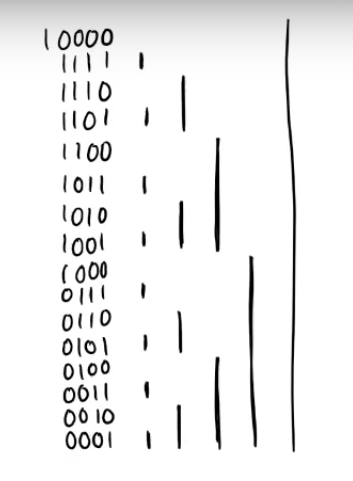
How to compute prefix sums?
- Take what you are responsible for.
- Staircase down.
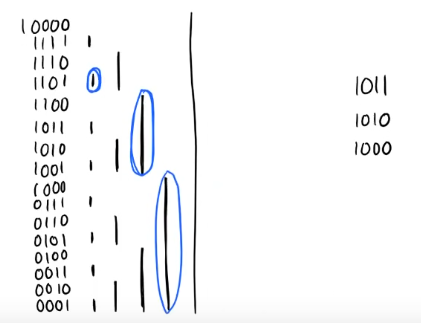
To staircase down, just remove the lowest set bit. Example:
1-based: 1011 -> 1010 -> 1000
          [1] -> [4] -> [8]
Adding all these values gives the prefix sum for or .
- The runtime depends on the number of bits, so in the worst case a query costs — there are at most bits in .
How to update?
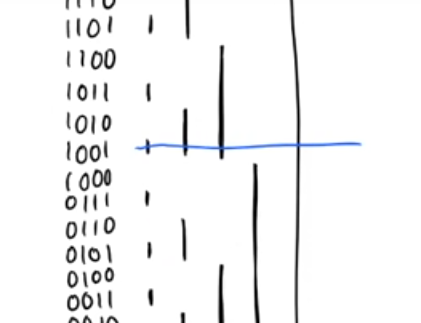
- To update an index, you must update all cells that own it.
For a given index, find which cells to update by drawing a straight line in the representation above.
- The BIT elements that need updating are all bits that are not set in the given index. Example:
1-based:
01001 -> 01000
 (9)
- --
[01010, 01100, 10000]
 - --   - --   - --
 (10)    (12)    (16)

0-based:
9 is at 1000
1000 -> 1001 -> 1011 -> 1111
 (9)    (10)    (12)    (16)
- Move by adding the lowest set bit to the current index with 1-based indexing. With 0-based indexing, move by setting the lowest unset bit, via
|.- Also runs in .
Example: -> -> -> .
How to find the lowest set bit?
Use bitwise AND: & .
Snippet
template <class T>
class BIT {
   public:
    vector<T> tree;
    int n;

    BIT(int _n) : n(_n + 1) { tree.resize(n); }
    BIT(const vector<T> &a) : BIT(int(a.size()) + 1) {
        for (int i = 0; i < int(a.size()); ++i) add(i, a[i]);
    }

    void add(int i, T delta) {
        ++i;
        while (i < n) {
            tree[i] += delta;
            i += (i & -i);
        }
    }

    T get(int i) {
        ++i;
        assert(i >= 1 && i <= _n);
        T sum{};
        while (i > 0) {
            sum += tree[i];
            i -= (i & -i);
        }
        return sum;
    }
    T get(int l, int r) { return get(r + 1) - get(l); }
};
Backwards BIT
- Range updates — add a given value to an entire range.
- Point query — query the value at a given index.
This can be done with normal BIT operations:
- A range update over is
BIT.add(l, delta)plusBIT.add(r + 1, -delta). - A point query is
BIT.get(i).