How does a segment tree work?.
February 17, 2022
A segment tree answers range queries — sum, min, max over [L, R] — in logarithmic time, with point and range updates to match. Here is the whole idea, bottom up.
How does a segment tree work?
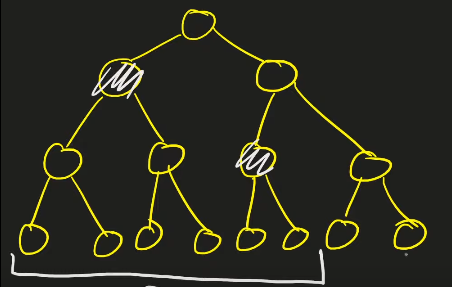
The array is first of all converted to a full binary tree. If we want the sum of the first 6 elements, we use the marked nodes and add them up.
How much time is taken to build a segment tree?
If we have 16 elements in the array (16 leaves in the binary tree), the level above has 8 nodes. Total nodes: 16 + 8 + 4 + 2 + 1 = 32 - 1. So roughly nodes, and building takes :
vector<int> a(n);
for (int &A : a) cin >> A;
while (__builtin_popcount(uint32_t(n)) != 1) ++n;

vector<int> tree(2 * n);
// build the tree
for (int i = 0; i < int(a.size()); ++i) {
    tree[n + i] = a[i];
}
for (int i = n - 1; i >= 1; --i) {
    tree[i] = tree[2 * i] + tree[2 * i + 1];
}
How to answer a query about a range?
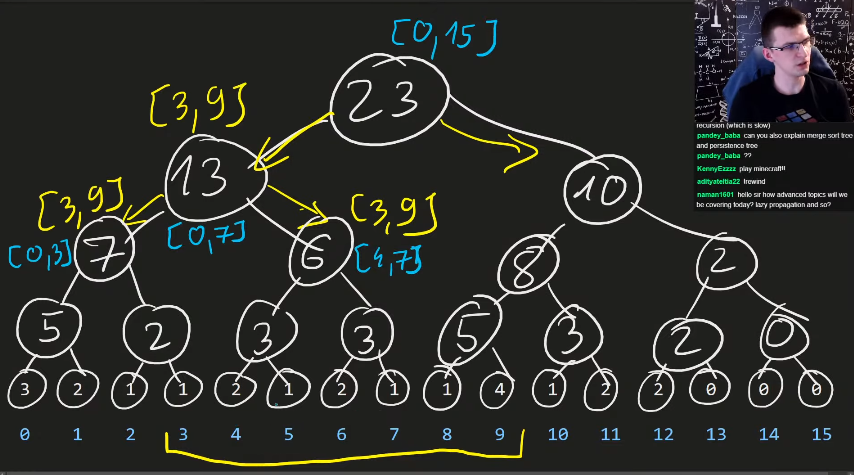
For a sum query over [L, R], start from the root and walk down, asking each node for the sum of [L, R] inside its range.
Note: if some subpart of [L, R] is completely present in the range covered by a node, we don’t go lower and directly include that value.
Source: Errichto
int f(int node, int q_lo, int q_hi){
    if(this node is completely within interval [q_lo, q_hi])
        return tree[node]; // tree[i] will contain sum contained in node i
    if(this node is disjoint with interval [q_lo, q_hi])
        return 0;
    return f(left, q_lo, q_hi) +
           f(right, q_lo, q_hi);
}
A better version with more details is:
int f(int node, int node_lo, int node_hi, int q_lo, int q_hi){
    if(q_lo <= node_lo && node_hi <= q_hi)
        return tree[node];
    if(node_hi < q_lo || q_hi < node_lo)
        return 0; // disjoint
    int last_in_left = (node_lo + node_hi) / 2; // rounded down
    return f(left, node_lo, last_in_left, q_lo, q_hi) +
           f(right, last_in_left + 1, node_hi, q_lo, q_hi);
}

f(ROOT, 0, n - 1, q_lo, q_hi); // n is power of 2 here
But what is left and right here?
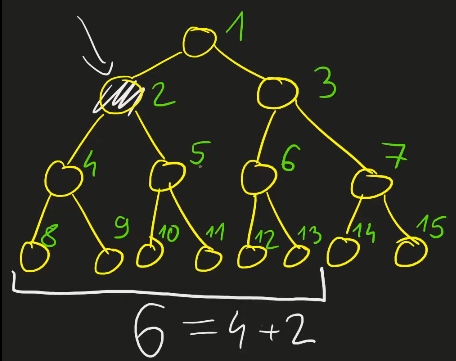
For any x, its children are 2 * x and 2 * x + 1, and the root is 1. So the code becomes:
int f(int node, int node_lo, int node_hi, int q_lo, int q_hi){
    if(q_lo <= node_lo && node_hi <= q_hi)
        return tree[node];
    if(node_hi < q_lo || q_hi < node_lo)
        return 0; // disjoint
    int last_in_left = (node_lo + node_hi) / 2; // rounded down
    return f(2 * node, node_lo, last_in_left, q_lo, q_hi) +
           f(2 * node + 1, last_in_left + 1, node_hi, q_lo, q_hi);
}

f(1, 0, n - 1, q_lo, q_hi); // n is power of 2 here
How to update the tree?
We know that an index i sits at n + i in tree[]. After updating a position, recalculate all its parents. For any node, its parent is node / 2:
// set a[i] = v
void update(int i, int v) {
    tree[n + i] = v;
    for(int j = (n + i) / 2; j >= 1; j /= 2){
        tree[j] = tree[2 * j] + tree[2 * j + 1];
    }
}
For the recursive version, do something similar to queries. The complete-overlap condition is met only at the actual position; the disjoint case returns early for nodes that aren’t parents. After updating a node, recompute the tree[] values on the way back up (post-call area):
void update_R(int node, int node_lo, int node_hi, int q_lo, int q_hi, int value) {
    if (q_lo <= node_lo && node_hi <= q_hi) {
        // happens only once when leaf [id, id]
        tree[node] = value;
        return;
    }
    // in disjoint just return
    if (node_hi < q_lo || q_hi < node_lo) return;
    int last_in_left = (node_lo + node_hi) / 2;
    update_R(2 * node, node_lo, last_in_left, q_lo, q_hi, value);
    update_R(2 * node + 1, last_in_left + 1, node_hi, q_lo, q_hi, value);

    // after updating now set, Post Call Area
    tree[node] = tree[2 * node] + tree[2 * node + 1];
};
Since the query and update functions look almost the same, you can merge them into one super function that does both based on a value parameter.
How much time does a query take?
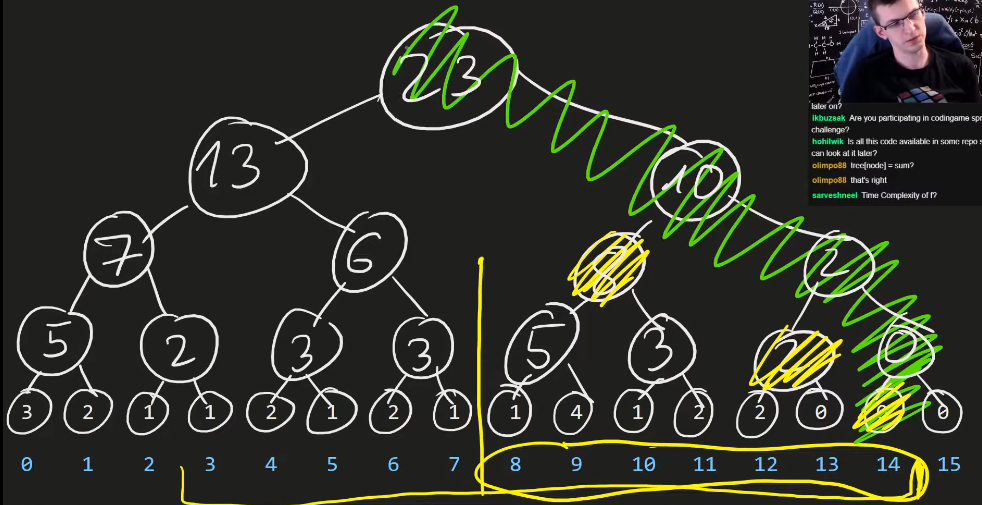
Note: for a query on range [3, 14], the path from root to 14 (marked green) is the farthest we travel; for the subranges we need at most 1 step to get [8, 11] and [12, 13] (marked yellow).
The same thing happens on both sides, so the time complexity is (the last 2 is because we visit 1 extra child on the way).
How to update a range and do point queries?
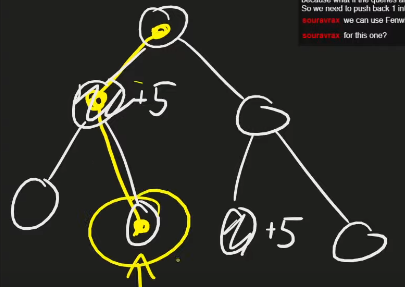
When updating a range, just update the parents that contain complete ranges; when querying, add up all the answers along the path from the node to the root:
vector<int> tree(2 * n);
// build the tree
for (int i = 0; i < int(a.size()); ++i) tree[n + i] = a[i];

//! as i dont want to compute sums of the complete ranges, i just want to update them when i want
// for (int i = n - 1; i >= 1; --i)
//     tree[i] = tree[2 * i] + tree[2 * i + 1];

auto query = [&](const auto &self, int node, int node_lo, int node_hi, int q_lo, int q_hi) -> int {
    if (q_lo <= node_lo && node_hi <= q_hi)
        return tree[node];
    if (node_hi < q_lo || q_hi < node_lo)
        return 0;
    int last_in_left = (node_lo + node_hi) / 2;
    int res = self(self, 2 * node, node_lo, last_in_left, q_lo, q_hi) +
              self(self, 2 * node + 1, last_in_left + 1, node_hi, q_lo, q_hi);
    return res + tree[node];  //! tree[node] as i ask my parents and add my own value
};

auto update_R = [&](const auto &self, int node, int node_lo, int node_hi, int q_lo, int q_hi, int value) -> void {
    if (q_lo <= node_lo && node_hi <= q_hi) {
        tree[node] += value;
        return;
    }
    // in disjoint just return
    if (node_hi < q_lo || q_hi < node_lo) return;
    int last_in_left = (node_lo + node_hi) / 2;
    self(self, 2 * node, node_lo, last_in_left, q_lo, q_hi, value);
    self(self, 2 * node + 1, last_in_left + 1, node_hi, q_lo, q_hi, value);
};
Hard question: SPOJ GSS3.