How does Dijkstra's algorithm work?.
October 10, 2021
Cities connected by flights with a cost per route — minimize the total cost from city A to city B.
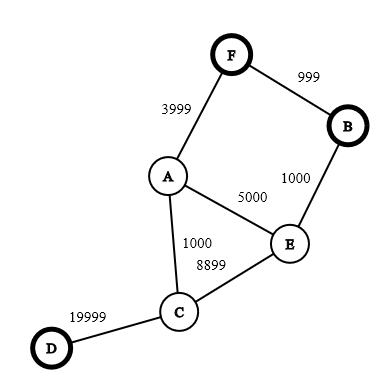
BFS would work here if the graph were unweighted, or if every flight cost the same.
One hack: convert everything to equal weights by inserting extra nodes along edges.
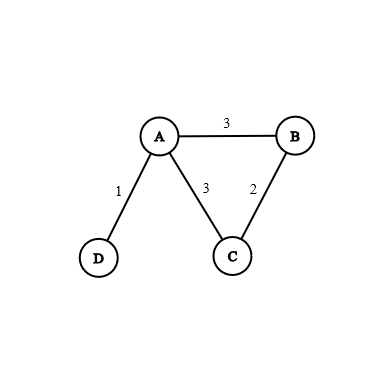
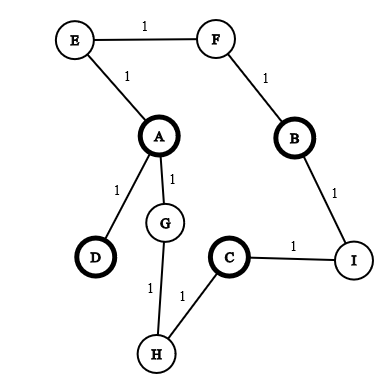
Now BFS applies. But there is a problem: long edges. If a weight is , we’d add absurdly many nodes — not feasible.
Key observation: nodes with smaller distances get visited first. That observation is the base of Dijkstra’s algorithm.
Algorithm
Just like BFS, but with a set (or priority queue) instead of a queue. Push {distance, node} into the set.
Initialize all distances to infinite. Push the source into the set, pop it, do the BFS thing: iterate all children (adjacent vertices); if the new distance is smaller than the recorded one, update it.
Code (C++)
const int INF = 1e9;

// Node and weight
vector<pair<int, int>> v[100005];
int d[100005];  // distance

int main() {
    int n, m;  // vertices, edges
    cin >> n >> m;
    for (int i = 0; i < m; i++) {
        int x, y, w;
        cin >> x >> y >> w;
        v[x].push_back({y, w});
        v[y].push_back({x, w});
    }
    // initially all nodes at INF distance
    for (int i = 1; i <= n; ++i) d[i] = INF;

    // source is 1.
    d[1] = 0;
    // distance 1st so it is sorted
    set<pair<int, int>> s;  //{distance, node}
    s.insert({0, 1});
    while (!s.empty()) {
        int dis = s.begin()->first;
        int vertex = s.begin()->second;
        s.erase(s.begin());

        for (pair<int, int> x : v[vertex]) {
            int newDis = dis + x.second;
            int newVer = x.first;
            if (newDis < d[newVer]) {
                //! can erase non existent element from set freely
                s.erase({d[newVer], newVer}); // erase old distance
                d[newVer] = newDis;  // update
                s.insert({d[newVer], newVer});
            }
        }
    }

    for (int i = 1; i <= n; ++i) {
        cout << d[i] << ' ';
    }
    return 0;
}
The time complexity is O(nlogm + mlogn), but usually m > n, so O(mlogn). Each edge pushes into the set (nlogm from set operations) and each vertex pops out (mlogn).
- Each node visited once.
- Each edge visited twice.
Storing predecessors with Dijkstra? Here.
Dry run
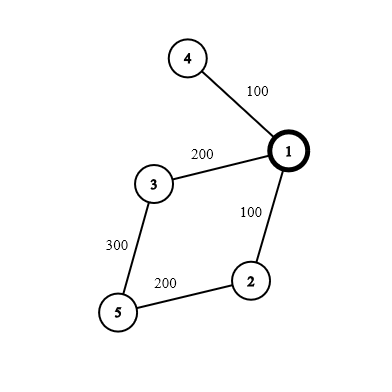
- After updating children, s = {(100, 4)}
- After updating children, s = {(100, 4), (200, 3)}
- After updating children, s = {(100, 2), (100, 4), (200, 3)}
- Before erasing parent, s = {(100, 2), (100, 4), (200, 3)}
- After updating children, s = {(100, 4), (200, 3), (300, 5)}
- Before erasing parent, s = {(100, 4), (200, 3), (300, 5)}
- Before erasing parent, s = {(200, 3), (300, 5)}
- Before erasing parent, s = {(300, 5)}
Finally, dis[] = {0, 100, 200, 100, 300}.
Multisource Dijkstra
A city map with traffic: travel time per road. Hospitals are blue, patients yellow — find the nearest hospital for each patient.
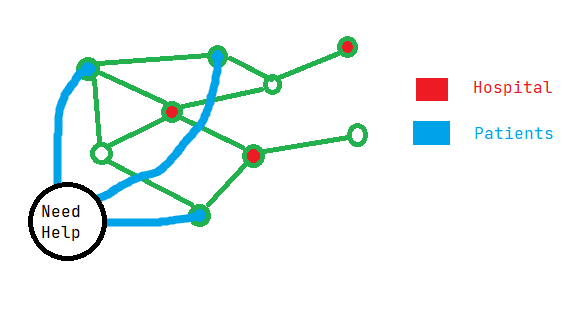
Create a "Need healthcare" node, connect all patients to it with weight 0, and run Dijkstra with it as the source for all hospitals. (Equivalently, insert all patients into the set up front.)
Cyclic and acyclic graphs
If A and B are 2 nodes in a cycle, there are at least 2 paths whose nodes are all unique.
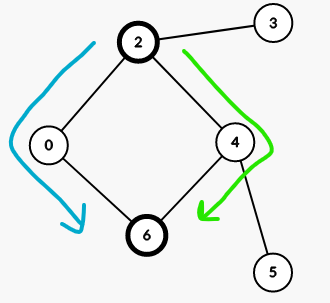
With no cycles, the path between any 2 nodes is unique. A cycle with N vertices has N edges.
Important points:
- A tree is a connected acyclic graph.
- A tree with
Nvertices hasN - 1edges. - An acyclic graph with many components is a forest — many trees.
Spanning tree
- A spanning tree connects all vertices with the minimum possible number of edges.
- It is always connected and never contains a cycle.
- It is always a subset of its graph — a disconnected graph can never have one.
- Buildable via BFS/DFS: since visited nodes aren’t revisited, the traversal itself generates the spanning (BFS/DFS) tree.
- One graph can have many spanning trees — not unique.
Minimum spanning tree
Defined for weighted graphs: the spanning tree of minimum total weight. Two algorithms: Prim’s and Kruskal’s.
Practice questions
A short starter set across the techniques above (starred by difficulty):
- DFS on grid — CSES 1192, CF 1033A
- Multisource BFS — CF 1593E, CSES 1194
- Dijkstra — CSES 1671
- Floyd-Warshall — CSES 1672
- Full topic-wise list: Learning/Graph in my Competitive-Programming repo
Part 1 of this series: how to store and traverse a graph.